Introduction
Human-Centric Assistive Robotic Systems (ARS) investigate autonomous mobile robots that operate safely and effectively in environments shared with people. Research focuses on developing generalized methodologies that enable robots to perceive, interpret, and respond to human behaviour while performing assistive tasks in dynamic and uncertain environments. Unlike traditional autonomous systems that rely solely on environmental sensing, assistive robots must also reason about human intent, preferences, activities, and contextual information to support robust decision-making.
Research at CIMLab integrates multimodal perception, person detection and tracking, human–robot interaction, semantic mapping, navigation, and adaptive decision-making into autonomous robotic architectures capable of assisting users in hospitals, long-term care facilities, offices, homes, and other human-centered environments. Particular emphasis is placed on uncertainty-aware perception, contextual reasoning, and autonomous search strategies that enable robots to locate, identify, and assist people despite incomplete information, changing environments, and unpredictable human behaviour.
Methodologies are validated through simulation and experiments using autonomous mobile robotic platforms operating in realistic human-centered environments. The resulting research contributes to the development of generalized decision-making methodologies applicable across a broad range of assistive and service robotic applications.
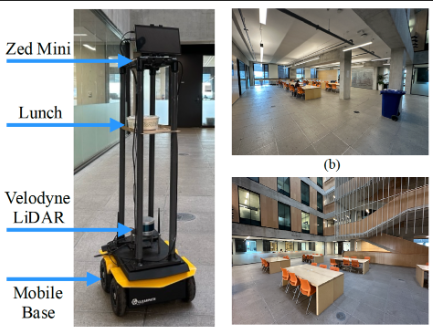
Representative Research: Development of Mobile Robot Architectures for Person Detection, Tracking, and Search – Angus Fung (PhD, 2025)
Selected Publications:
Fung, A., Benhabib, B., & Nejat, G. (2025). LDTrack: Dynamic People Tracking by Service Robots Using Diffusion Models. International Journal of Computer Vision, 133(6), 3392–3412.
DOI: 10.1007/s11263-024-02336-9
Publisher: https://doi.org/10.1007/s11263-024-02336-9
Hong, A., Lunscher, N., Hu, T., Tsuboi, Y., Zhang, X., dos Reis Alves, S. F., Nejat, G., and Benhabib, B. (2021). A Multimodal Emotional Human–Robot Interaction Architecture for Social Robots Engaged in Bidirectional Communication. IEEE Transactions on Cybernetics, 51(12), 5954–5968.
DOI: 10.1109/TCYB.2020.3047206
Publisher: https://doi.org/10.1109/TCYB.2020.3047206
Nuger, E., & Benhabib, B. (2018). A Methodology for Multi-Camera Surface-Shape Estimation of Deformable Unknown Objects. Robotics, 7(4), 69.
DOI: 10.3390/robotics7040069
Publisher: https://doi.org/10.3390/robotics7040069